

Saint of the Week: William Reed Huntington
7/30/2025
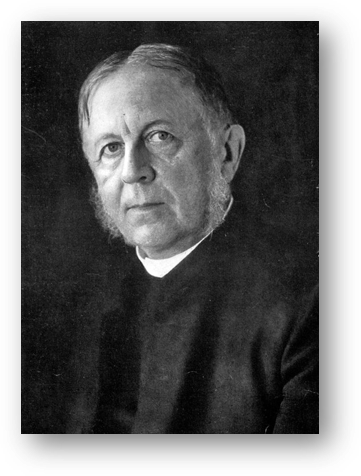
William Reed Huntington
Priest and Influencer
1838 – 1909
Although never a bishop, William Huntington had more influence on the Episcopal Church than most bishops. An ecumenical leader and liturgical reformer, Huntington was known as the "First Presbyter of the Church.“ Born in Lowell, Massachusetts, he was the son of a physician, studied at Harvard, and was ordained a priest in 1862. In each of the 13 General conventions (held every three years, in years that have a remainder of 2 when divided by 3) of the Episcopal Church that met between 1870 and his death, he was a member, and indeed the most prominent one in the House of Deputies. In 1871 he moved for the restoration of the ancient Order of Deaconesses, which was finally officially authorized in 1889. His parish became a center for training deaconesses. Huntington's was the chief voice for revising the Book of Common Prayer (completed in 1892)—his was the greatest single influence on the process of revision. The prayers he wrote for it include the following, used during Holy Week and on Fridays: “Almighty God, whose dear Son went not up to joy but first he suffered pain and entered not into glory before he was crucified: Mercifully grant that we, walking in the way of the cross, may find it none other than the way of life and peace; through the same thy Son Jesus Christ our Lord.”
In his book The Church Idea (1870), Huntington sought to discuss the basis of Christian unity, and he formulated the Chicago-Lambeth Quadrilateral, a statement adopted first by the House of Bishops of the Episcopal Church in 1886 and then, with slight modifications, by the Bishops of the Anglican Communion at Lambeth in 1888. The statement set four principles which Anglicans regard as essential and offer as a basis for discussion of union with other Christian bodies (Ref: 1979 U.S. Book of Common Prayer, pp. 876-7). Note that those four points of the Lambeth Quadrilateral: Scriptures, Creeds, Sacraments, and Ministry, correspond roughly to the points listed in Acts 2:41, where Luke speaks of those who received the Gospel as preached on Pentecost: “So those who received his word were baptized, and there were added that day about 3,000 souls. And they continued steadfast in the apostles' doctrine and fellowship, and in the breaking of bread, and in the prayers.
These early Christians were in the apostles' doctrine. That is, they believed what the apostles taught about the Resurrection of Jesus, and about His victory on our behalf over the power of sin and death. That is to say, they believed the doctrine summarized in the Creeds.


